Category: Learning
Creating…Ourselves
 In my day job, as a researcher, we have found that when children make things with their hands – especially when they copy designs made with creative materials – it helps their behavior, attention, and achievement.
I have begun to see our human desire to create everywhere.
Cooking, writing, painting
Sewing, singing or songwriting
Gardening and woodworking
Photography
and not least of these, blogging.
As a writer I’ve become more consciously aware that I need to write in order to sort things out. Writing helps me create sense and order out of the noise in my head. This 21st century life is so full of details – emails, news updates, constant status updates and FB posts.
Eckhart Tolle writes about “the noise in your head that pretends to be you and never stops talking.” Though he advises simply pausing, acknowledging the noise without spinning off into an alternate reality, I think of writing as a halfway point. Halfway between the chaos of confusion and the perfect simplicity of silence, is an orderly set of thoughts on paper (or screen).
The quiet that emerges after a good writing session feels like the earth after a good hard rain. The air feels cleaner and lighter. The forest is quiet and can be seen through the trees.
The canvas is cleared, to begin again, to make room for another noise, another mess, another “sorting out of things.”
Being Kind to Myself: The Email Diet
Today I put myself on an email diet. Which means I’m allowed to check email three times per day. This applies to my work and personal email accounts, and even with the limit, I probably had my email open for almost two hours. But compared to my usual habits of leaving it up all day, this was a huge improvement. And I get to use this snazzy chart:
| mon | tues | weds | thurs | fri | ||||||||||
| 1 | 2 | 3 | 1 | 2 | 3 | 1 | 2 | 3 | 1 | 2 | 3 | 1 | 2 | 3 |
| 1 | 2 | 3 | 1 | 2 | 3 | 1 | 2 | 3 | 1 | 2 | 3 | 1 | 2 | 3 |
| 1 | 2 | 3 | 1 | 2 | 3 | 1 | 2 | 3 | 1 | 2 | 3 | 1 | 2 | 3 |
| 1 | 2 | 3 | 1 | 2 | 3 | 1 | 2 | 3 | 1 | 2 | 3 | 1 | 2 | 3 |
| 1 | 2 | 3 | 1 | 2 | 3 | 1 | 2 | 3 | 1 | 2 | 3 | 1 | 2 | 3 |
| 1 | 2 | 3 | 1 | 2 | 3 | 1 | 2 | 3 | 1 | 2 | 3 | 1 | 2 | 3 |
| 1 | 2 | 3 | 1 | 2 | 3 | 1 | 2 | 3 | 1 | 2 | 3 | 1 | 2 | 3 |
| 1 | 2 | 3 | 1 | 2 | 3 | 1 | 2 | 3 | 1 | 2 | 3 | 1 | 2 | 3 |
| 1 | 2 | 3 | 1 | 2 | 3 | 1 | 2 | 3 | 1 | 2 | 3 | 1 | 2 | 3 |
| 1 | 2 | 3 | 1 | 2 | 3 | 1 | 2 | 3 | 1 | 2 | 3 | 1 | 2 | 3 |
| 1 | 2 | 3 | 1 | 2 | 3 | 1 | 2 | 3 | 1 | 2 | 3 | 1 | 2 | 3 |
| 1 | 2 | 3 | 1 | 2 | 3 | 1 | 2 | 3 | 1 | 2 | 3 | 1 | 2 | 3 |
Over the past few weeks I realized I was on email overload. Email had become my go-to procrastination activity, but unlike watching Arrested Development, it was also what could send me into panic mode most reliably. I used to leave work, unsure of what I had accomplished, but feeling completely fried.
We have just come through a period of deadlines at work, where I needed (or pretended that I needed) to keep email open all the time in case something time-sensitive appeared. But having my brain on constant alert mode meant I was attempting to keep vigilant attention all day, which is exhausting. Not to mention, about half of the incoming emails required a response, so I was also adding to my to-do list several times per hour.
A few conversations helped me confirm that I’m not the only person suffering from email fatigue. Colleagues shared strategies like reading email twice per day, once in the morning and again in the late afternoon; or anytime except for morning writing sessions; or replying to emails about certain topics on certain days. I even heard of a somewhat complex system of replying promptly when not working on a paper, and replying with a canned “I’ll get back to you in 2 weeks” when working on a paper.
When I mentioned my new email diet to a student, she acknowledged she does the same thing, and admitted that she’s afraid she’ll miss something important. She rattled off all the different lists that provide regular, sometimes time-sensitive, information: coursework, program announcements, student news and events, and our lab announcements.
Our culture challenges us with “too much of a good thing” habits: flying on airplanes, watching television, checking email. As much as I appreciate my information economy job, it’s making me tired, and there are no structures in place where I work to help my email behavior improve.
The first hurdle was identifying the problem. I don’t think I wanted to admit to myself that I “couldn’t handle” having my email open all day. Like an addict, I thought it was under my control and that I could stop at any time. I also compared myself to other colleagues, assuming they were on email all the time, asking myself why they could do it when I seemed to be tiring myself out.
Then the light bulbs began to go off: first, I recalled the words of one colleague who I believe manages his email better than I do (his five young children probably provide some extra incentive): “Emails beget emails.” Which means replying to emails – “tidying up” –exacerbates instead of solves the problem.
Second, I realized that I don’t sit around waiting for people to reply to my emails. Okay, sometimes I patiently await a reply, but it’s probably every tenth one. The others I forget about as soon as I’ve hit “send.” So I’m going to assume that 9 out of 10 people who email me aren’t worried about when I respond. Which is a high-tech translation of “I’m not nearly as important as I think I am.”
Finally, I gave myself a break. I decided it’s okay if I become tired at work and if I become tired from checking email. I decided I’m not Super Email Woman (apparently someone is. The internet is amazing). Instead, I’m Normal Brain Lady.
This last insight was difficult. I was reading an essay this morning by Diane Ackerman and she shared the simple, “why didn’t I think of that” idea that her energy is finite. She wrote that in one morning, she can either write, OR talk to a friend, OR answer emails. But not all three. And it’s okay, because she’s Only Human.
Imagine that. (And now, with my extra brain energy, from being kind to myself, I can).
Love is an Ability
For Mother’s Day this year I would like to thank my mom for her ability to love.
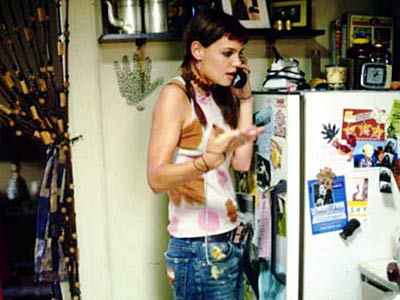
I first learned about this idea of love from the special features following the film “Pieces of April.” Derek Luke, who plays Bobby in the film, says the movie is unique because of its message about love. Through the magnificent failings of all its quirky (did I say quirky? I meant dysfunctional) characters, the film shows that love is an ability, not a feeling. Which means it is something that can be learned, a word I usually associate with school.
While I learned about the importance of effort in academic pursuits in graduate school (and boy, did I!), it took me longer to realize that the same effort could be applied to learning emotional and relationship matters. And though I began my academic learning when attending school for the first time, my ways of feeling, reacting, and relating to others had been practiced and reinforced since I was born.
When certain behaviors, like a particular way of responding when another person speaks, are practiced over and over again, they create “super-highways” in the brain. After that, they become the default behavior – the impulse, the automatic response, or the thing that is easiest to do without thinking. For example, if a child is often hungry as an infant, that child will probably react to a snack by eating it immediately when it appears. If the child has never had the opportunity to practice waiting to eat snack, he probably won’t be very good at it: behaviors that aren’t practiced are like roads that don’t get driven on. They simply disappear.
When anything threatening or uncertain happens, my default reaction – my superhighway – is anger. Lashing out, raising my voice. It doesn’t necessarily have to mean that I’ve been personally threatened – it could be something as simple as someone disagreeing with me. On the phone one night, my mom and I were discussing what I should do about my fatigue. I was (idiotically) trying to figure out a way to continue in my three after-work hobbies: a cappella chorus, weekly writer group, and monthly writer group. I’ve been on a schedule overload like this since high school, and my mom was trying to encourage me to rest:
My mom: “What if this is your window to rest and recover, and what if you spend it too busy? You may miss that window and end up tired…for the rest of your life.”
Me (angry): “What did you need to go and say that for? Don’t you think that’s what I’m worried about most?”
I was angry because my mom had said exactly what I was thinking. It’s kind of ironic to get mad at someone for essentially agreeing with me. But like many default reactions, anger is a defense mechanism meant to deflect other negative feelings like feeling scared (in this case), or ashamed or ignored. It is not a very useful response, because no matter what the anger is directed towards – a person, the store that’s out of a key ingredient, a flat tire – the anger usually shuts down the situation instead of resolving it.
In the past couple years, I decided that I needed to find a way to either avoid anger in the first place, or (more realistically) to do something besides go into attack mode when I felt it. The process was (is, I must admit) messy and stilted. In emotional conversations, I often become angry anyway, even after telling myself it won’t happen. (I once made myself a little note – a “yellow card” like in soccer – to use when I was feeling over the edge; I was in Italy during the World Cup at the time).

It helped when a teacher reminded me that “when under stress, regress,” which means, when a person is under stress, she reverts to her original ways of handling a situation. This helped me to have patience with myself when I was trying to lay down the new highway in my brain. It helped me to realize that even if I didn’t always succeed in managing anger, it was important that I was trying, and some day, I might succeed.
Eventually, after a much longer time than expected, I became able to feel anger and not do or say anything about it. I can “just be” and let the feeling occur. Sometimes, magically, I can even say, “I want to talk about this, but can we do it later?” Other times, it is like my car has stalled on the highway. I won’t let it go any further down the anger road, but it doesn’t have anywhere else to go. So I remain silent, staring, remembering my breath. And still other times, when I am at my most vulnerable, the anger still comes.
My mom has stuck by me in all of this. She has talked and listened on too many phone calls to count (though my cell phone company is delighted to count them). For several months last year, we talked on the phone every single night. I was going through a divorce, plus dealing with health problems, and was not the most cheerful of conversationalists. But my mom was there, putting in the time, listening and responding. Sometimes I even asked her for a different response, which she remarkably was able to give. And many, many times, my mom responded with wisdom and kindness, with words I didn’t even know would make me feel better and with stories that helped me see the strength and dignity in our human plight. She helped me see the value of having the world tumble down around our feet. She helped me find my own particular strength and dignity.
My mother is not a perfect person (I always wonder why that seems like a disclaimer. As far as I know, not one of us is perfect so this is a way of saying “she is a human being, not a robot” which is intended as a compliment). But my mom has a quality that I admire a lot: she tries, really hard, to love. She sees love as an ability and as something you can show a person through words and actions. She believes that people can change their words and actions, that she can change and I can change for the better – “for the healthier.” She is able to love me. And she succeeds.
Thank you, Mom, for all that you’ve done, to get me here, to today. I’m more grateful than words can say (But like the academic I am, I shall try).
New Habits
This afternoon I was stretching in the bedroom of a friends’ house where I’m pet-sitting for the weekend. While the older dog Sadie napped nearby, it took only a few minutes for the younger beagle, Belle, to figure out that I was on the floor.
Belle has spent much of her time since I arrived yesterday watching me. She figured out immediately that I’m a grazer, likely to be eating food at any given moment, so I don’t blame her for watching my every move. When I sat on the floor, to Belle that meant I was available to pet her. My parents’ 2-year-old terrier, Roscoe, thinks it’s time to wrestle and nips at my ankles and wrists when I’m on his level (roughly knee-high). Any attempt at a calm Yoga session in the morning turns into puppy playtime. In my parents’ home, set at the edge of a swath of state-owned forest, furnished with my dad’s custom-built woodwork, I’m happy to indulge Roscoe. He’s always been available for puppy play, but I know that someday soon, he will be a jaded adolescent dog, content to lay in a corner. So I always play.
The house I’m in this weekend reminds me of my parents’ in lovely ways. It has the warm tones of wood throughout and an indoor-outdoor space that the dogs traverse all day. It has the unmistakable permanent feeling of family, of being a place where people have chosen to settle down while children and pets, like Belle and Sadie, grow older.
Whenever I’m around other people’s pets, I’m impressed by how easily the animals adapt to me (and in this case, my boyfriend). I don’t know how they decide we won’t harm them, though I assume it’s something to do with how we smell. (It’s comforting to know that I don’t smell angry or cruel). But beyond that, I’m sure we keep a different rhythm compared to their human owners. Shouldn’t they act more confused? But Belle, Roscoe, and their kind don’t require much beyond food at the right times, time every day spent outside, and companionship.
They don’t really demand it though. They wait, observe, and remind with a look or whine if food or water is forgotten. When it’s delivered, they react with rapture. “Appreciate” is an understatement for dogs’ enthusiasm for the basic necessities. When you fill their food dish, take them for a walk, or scratch their bellies, they simply love you. I feel embarrassed at how much dogs seem to love me for doing the most basic of caregiving tasks. A part of my brain says, “Is that all it takes to make another creature happy? What does anyone need a PhD for?” But it’s in their nature to love that way, and thank goodness. Dogs have helped many humans, otherwise at the edge of their sanity, remain attached to the daily gift of existence and of habit. I’m sure of it.
…
In his book The Social Animal, David Brooks describes the ideal learning experience as a series of excursions into a novel place, back to a safe and secure base. For dogs, it may be a source of sustenance and kindness; for babies, that base is a comforting, stable parent. Brooks says that adults have the same need to explore and return, explore and return. Habit and break from habit.
I’ve spent my adulthood at universities, away from my parents’ home. It would be a euphemism to describe the past few years as a “learning experience.” In a decision that felt more like an earthquake, I decided not to pursue a tenure-track position in academia, got divorced, and began dealing with a series of health mysteries that, while not terminal, still take up huge amounts of my time and energy. I have spent the last year learning to rest. Often I have imagined myself in my parents’ peaceful wooded home, taking a break from all the questions and worries swirling around in my head about all these changes.
I have also realized that the same questions and worries will be there waiting whenever I return to my working life, as a professional. If I stayed at my parents’ long enough, they would arise. They are there because I’m a human being, who has a brain and a body and the things that a brain and a body produce: thoughts, feelings, worries, questions. What I’m working on now is a new set of habits, and I’m not embarrassed to say they’re habits that Belle and Roscoe, who are dogs, exhibit as part of their nature.
Observe. Be available. Appreciate. Love.
 claire e. cameron